
Exam Questions
Please note that the exam will not cover all the questions listed in this questionnaire. Each exam will include a selection of questions from each category. While you need to be familiar with all the content, the actual exam will contain fewer questions.
A-01. Which body of the same frontal cross-section and at the same speed offers least drag?
A-02. Which body of the same frontal cross-section and at the same speed offers most drag?
A-03. We describe laminar airflow as:
A-04. How does the profile of a paraglider get shape?
A-05. Where does the force of gravity pull?
A-06. The drag is pulling in the direction of:
A-07. Which force is pulling against the force of gravity during the glide?
A-08. What is the glide angle?
A-09. What is the name of the resultant of the lifting power and the drag?
A-10. The lift is pulling:
A-11. At what angle the lift is pulling, regarding to the airstream?
A-12. Which factor is irrelevant for the lift force?
A-13. How the lift is distributed over the wing?
A-14. The airstream over the upper surface of the paraglider profile is:
A-15. The lift is result of:
A-16. Which statement is correct?
A-17. What is the correct distribution of lift on a bent asymmetric airfoil?
A-18. Where on the paraglider do we find mostly negative pressure?
A-19. Thick and strongly bent airfoil provides:
A-20. What do we achieve with pulling the front risers?
A-21. What is true when we push accelerator (speed bar):
A-22. What is true when we push accelerator (speed bar):
A-23. If the rear lines of the glider are shortened:
A-24. What can happen if A and B lines are stretched?
A-25. How does the center of pressure move as we increase the angle of attack?
A-26. While flying slow we increase angle of attack, so:
A-27. Danger of losing the lift is especially critical:
A-28. What is dangerous, when we pull brakes for too long?
A-29. During full stall:
A-30. What can increase the glider’s tendency to stall?
A-31. What can happen if the brake lines are set 40 cm too short?
A-32. What happens if brake lines are set 15 cm too long?
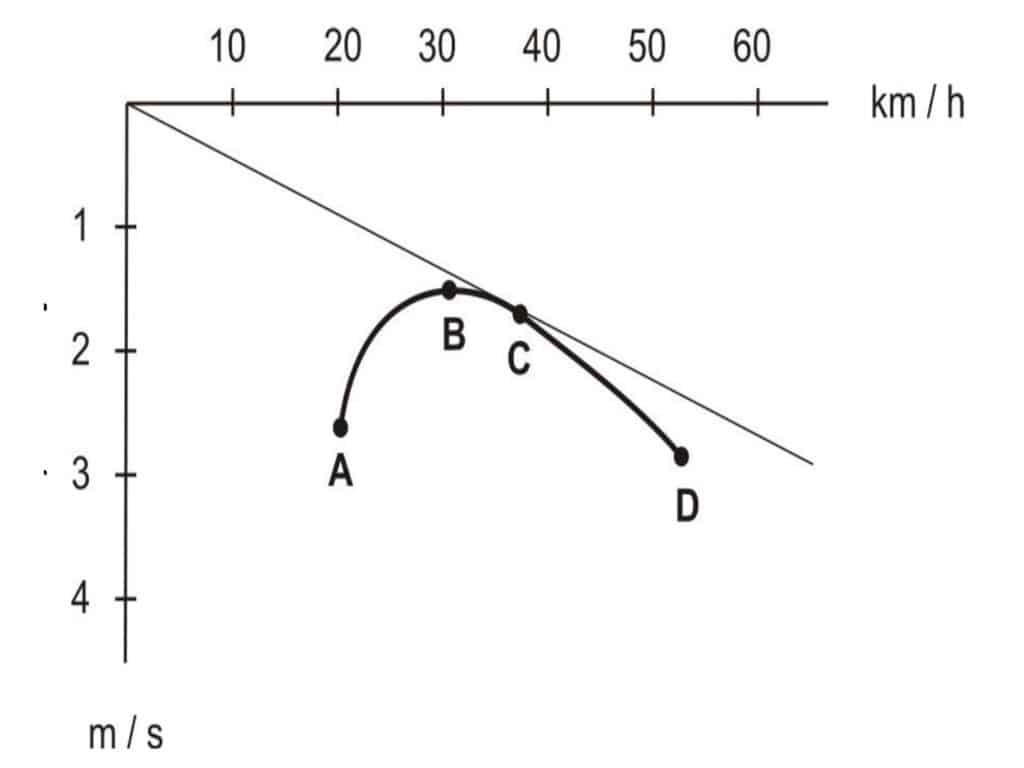
A-33. From wing’s polar curve we can see:
A-34. In the polar curve, the lowest sink is at point (Annex nr. 1):
A-35. Which is the point of the best glide (Annex nr. 1)?
A-36. When we reach the best glide speed with gliders class A or B?
A-37. Usually the glider in A-B class has the minimum sink while flying as follows:
A-38. When the glider is flying at the minimum speed:
A-39. Glide angle number tells:
A-40. What is the glide ratio of the glider, which in calm conditions flies 4.2 km distance from 600 m relative altitude?
A-41. Glider flies in calm conditions 1800m distance from 300m relative altitude. How far can it fly from 2100 m of relative altitude?
A-42. If the air speed is 34 km/h and there is a 17 km/h headwind:
A-43. What is the true airspeed?
A-44. Which is the most important speed for flying?
A-45. If pilot flies without braking:
A-46. What speed should a pilot fly in a thermal to reach max. climb?
A-47. How should a pilot fly in wide, weak thermals?
A-48. Increased wing load causes:
A-49. How does the higher wing load affect the speed?
A-50. How does the higher wing load affect the maximum speed?
A-51. Heavier pilots fly relative to lighter pilots (with the same glider):
A-52. Which types of drag affect the glider during the flight?
A-53. Equalizing of pressures on the wing tips causes:
A-54. Wings with higher aspect ratio have:
A-55. Pitch stability means:
A-56. At sudden gusts of wind or when entering a strong thermal, the glider swings around:
A-57. The drag of the body, at the same angle of attack, is increasing with speed:
A-58. The drag, caused by the airflow, changes with increased surface of the wing (at the same speed):
A-59. Flying in turn automatically means:
A-60. Which is the additional force, working in the turn, compared to the straight level flight?
A-61. What is happening with wing load in the turn (compared to the straight flight)?
A-62. Take off place must be chosen so that:
A-63. When do we execute five control points procedure?
A-64. Your glider has approx. 40 cm long crack in the third cell. Can you take-off anyway?
A-65. How do we abort take-off?
A-66. While soaring on the slope we must never turn:
A-67. What must pilot do immediately after landing?
A-68. How do we land on the slope?
A-69. Very tight (too short) chest strap of the harness:
A-70. In turbulent air, a pilot needs to:
A-71. The expression "twist" in paragliding stands for:
M-01. How do we name the gas layer around the earth?
M-02. Tropo, strato, meso, iono sphere are:
M-03. In which layer of the atmosphere the weather occurrences are happening?
M-04. What is the value of air density in the international standard atmosphere (by ICAO)?
M-05. The temperature drop with altitude in the international standard atmosphere (by ICAO) is:
M-06. Instrument for air pressure measurements is?
M-07. What is the app. pressure at the sea level?
M-08. How does the air pressure change with increasing altitude?
M-09. What is happening with density of oxygen in troposphere as altitude is increasing?
M-10. Which component of the air has the major role in weather phenomena?
M-11. Term 'dew point' means:
M-12. Why do clouds form in the atmosphere?
M-13. The amount of water vapour that can be contained in the air depends on:
M-14. The amount of water vapour that can be held in the air depends on:
M-15. Which air mass is the warmest and most humid?
M-16. At which phase transition is heat generated and what is the name of the transition?
M-17. Dry air raising adiabatically is cooling:
M-18. Wet air raising adiabatically is cooling:
M-19. What is katabatic wind?
M-20. What is the rotation direction of low pressure and high pressure air mass on the northern hemisphere?
M-21. Increasing cloudiness, rain, cloudiness disintegration, raising air pressure is typical for:
M-22. Where the large areas of raising air masses can be found?
M-23. Which are the areas of descending air masses and what is the state of stability there?
M-24. Consequence of the air mass descending in the summer anticyclone is:
M-25. Which inconvenient weather phenomena are characteristic for winter anticyclone?
M-26. At what distance in front of the coming warm front the first cirrostratus and altostratus clouds appear?
M-27. Appearing of cirrus clouds usually means coming of:
M-28. Which is the usual wind in Slovenia before a cloud front from the west?
M-29. How do warm and cold air masses move in the warm front?
M-30. How do warm and cold air masses move in the cold front?
M-31. Which weather phenomena are typical for a summer cold front?
M-32. Which clouds are especially typical for cold fronts?
M-33. Which are the high clouds?
M-34. Which clouds always consist of ice crystals?
M-35. Medium height clouds are:
M-36. Which cloud stretches over all three cloud levels?
M-37. Wave lifts behind mountain ridges can be marked with lens-shaped clouds, named:
M-38. Clouds with severe turbulence are:
M-39. From which clouds do we usually not expect precipitation?
M-40. From which clouds we can expect thunderstorms?
M-41. What is the criteria for atmosphere stability?
M-42. What type of clouds and weather could be expected in the summer with humid and labile air mass?
M-43. Humid and unstable air mass is during the summer recognized by:
M-44. What is temperature inversion?
M-45. Typical for temperature inversion is:
M-46. What is the reason for ground inversion?
M-47. What is causing the wind?
M-48. What does the mark 270/5 in aviation mean?
M-49. Approximately how fast is 20 knots (kt)?
M-50. Approximately how many knots (kt) is 45 km/h?
M-51. 10 knots (kt) is approximately:
M-52. Lenticularis clouds could be the sign of:
M-53. What is foehn wind?
M-54. Turbulence can appear in an open atmosphere:
M-55. What is thermal lift?
M-56. What is dynamic lift?
M-57. Which areas are warming up fastest?
M-58. Thermals are most frequent above:
M-59. What is the best angle of the sun to warm up the ground fastest?
M-60. The intensity of the thermal mostly depends on:
M-61. What is true for the lee side thermals?
M-62. On a good thermal day, the wind in closed alpine valleys is blowing:
M-63. Which clouds are the consequence of thermal convection?
M-64. Which type of clouds appear in the spring and summer on a clear sky due to intense ground heating?
M-65. What is known as dry adiabatic (blue) thermals?
M-66. When can we expect heat storms in the spring and summer?
M-67. Before noon there were cumulus clouds; at noon, the sky is almost overcast. What should we count on?
M-68. Which phenomenon is the most dangerous when flying near a thunderstorm?
M-69. How strong can the lifts be in a storm cloud?
M-70. What can we expect if we get sucked into a cumulonimbus cloud?
M-71. Where can we expect turbulence when flying in a thermal?
M-72. What can we expect when exiting a strong thermal?
M-73. Can we expect turbulent air on a clear day above flat areas with no obstacles?
M-74. What should be done when we see dark blue-blackness on the horizon, realizing a thunderstorm is approaching?
M-75. What can we expect on takeoff facing S if a light to moderate E wind is blowing?
M-76. What should we count on when landing on a small field with many obstacles and wind blowing?
M-77. What can we expect on a landing field with obstacles nearby (trees, houses, etc.) when moderate wind is blowing?
M-78. What is true when flying in dynamic lift?
M-79. What can we expect on the lee side when strong general wind is blowing?
M-80. Can we fly on the N slopes of Karavanke range when SW wind is blowing?
M-81. On an open space, wind is blowing at 4 m/s. What can we expect when the valley narrows?
K-01. What is the purpose of diagonal ribs?
K-02. How is airfoil thickness usually defined?
K-03. Openings in the ribs are intended to:
K-04. Which lines are carrying 3/4 of the weight?
K-05. Load capacity of A and B risers must be:
K-06. Which weight must be considered for the wing load?
K-07. What data do we need to calculate wing load?
K-08. What should be the wing load of a paraglider?
K-09. What should be the wing load of a higher aspect ratio glider?
K-10. What are possible consequences of too low wing load?
K-11. Pilot weighs 80 kg, equipment with the wing included 18 kg. Glider's surface is 28 m². What is the wing load?
K-12. Glider weighs 5 kg, pilot with equipment weighs 75 kg. In deep spiral, the force on the pilot is 2g. What does that mean?
K-13. What is the aspect ratio?
K-14. What is the formula for calculating the aspect ratio?
K-15. Which glider has the biggest aspect ratio?
K-16. The surface of the glider is 26 square meters, wingspan is 11 m, take-off weight is 100 kg. What is the aspect ratio?
K-17. Which construction parameter has the biggest influence on flying performance of a paraglider?
K-18. What will you do if your glider often enters a stall for a short time?
K-19. What can cause increased porosity on the upper surface of the wing?
K-20. How do we check technical suitability of the glider?
K-21. What are the factors when choosing the glider?
K-22. What affects the solidity and aging of the glider most?
K-23. Does UV radiation weaken the gliders fabric?
K-24. How should pilot approach when we have strong sun radiation?
K-25. Which fluid can we take to clean the glider?
K-26. What will you do with the glider after saltwater landing?
K-27. Compatibility of the harness and rescue parachute with an opening system must be checked (test of compatibility K-test):
K-28. Why is it not recommendable to store the glider for a longer time in a sealed package?
K-29. What makes the fabric for paragliders air-tight?
K-30. What is the minimum allowable throughput of material on the upper front wing measured by porozimeter MK-1 for the paraglider to still meet technical requirements?
K-31. What is "Rip-Stop" material?
K-32. How does rain affect the glider?
K-33. What can happen when flying in rain?
K-34. Which statement about the optimal load of the rescue parachute is correct?
K-35. What is important for rescue parachutes?
K-36. Which weight must be considered when choosing the rescue parachute size?
K-37. What is the best attachment of the rescue parachute to the harness?
K-38. Why is it good that the parachute is attached to the harness at shoulder straps?
K-39. What is an important advantage of a front container?
K-40. What should we be careful about when the rescue parachute is installed in a front container?
K-41. What is the aim of the vent on the top of the round parachute?
K-42. When must we check the opening system of the rescue parachute?
K-43. When is it recommendable to refold the rescue parachute?
K-44. What is the most important in setting the harness chest-strap?
K-45. What is the aim of the protector?
K-46. What code is used in Europe for paragliding testing since 2009?
K-47. How many categories does the EN 926-2 test have?
K-48. What is typical for A and B class paragliders?
K-49. Paragliders in A and B class must not enter deep spiral according to the EN classification:
E-01. What is asymmetric collapse?
E-02. How do we react on asymmetric collapse?
E-03. What is the difference between large asymmetric collapse (70% of the wing) and smaller one?
E-04. What are the risks of asymmetric collapse?
E-05. At large asymmetric collapse (over ½ of the wing):
E-06. What is the most dangerous if a pilot reacts on asymmetric collapse with too much brake on the outer side and stalls the glider?
E-07. What should be the first reaction of the pilot after asymmetric collapse of accelerated glider?
E-08. What is cravat?
E-09. I take off with incomplete visual check, on the right side of the wing I have small cravat. What should I do?
E-10. I couldn’t release cravat with known manoeuvres, gliders fly a bit out of direction. What should I do?
E-11. What is true for A and B class gliders when 1/3 of the wing gets tangled between the lines (cravat)?
E-12. Big asymmetric collapse ends up with cravat. More than 1/3 of the wing gets stacked, glider starts to spin. What should pilot do?
E-13. What is frontal collapse?
E-14. What can cause the frontal collapse?
E-15. How do we recover from frontal collapse?
E-16. How do we perform big ears?
E-17. How do we control the wing with big ears?
E-18. How we can make big ears more efficient for losing height?
E-19. What is maximum vertical speed with big ears?
E-20. What are the dangers of big ears?
E-21. Exit from big ears:
E-22. Enter in the spiral dive:
E-23. What is vertical speed in a spiral?
E-24. Why is the spiral dive a dangerous manoeuvre?
E-25. What is significant for deep spiral (stable spiral)?
E-26. At which speed even low-class paragliders can enter deep spiral?
E-27. Exit from the spiral dive:
E-28. What is B-stall?
E-29. We perform B-stall by:
E-30. What do we have to watch out for while entering the B-stall?
E-31. What are Vh and Vv in the B-stall (Vh=horizontal speed, Vv=vertical speed)?
E-32. Exit from B-stall:
E-33. Under what circumstances during B-stall can the wing massively surge forward, leading to the possible loss of control?
E-34. What is deep stall?
E-35. How do we recognize deep stall?
E-36. What is the inner pressure of the wing during the deep stall?
E-37. How does a stalled wing look like?
E-38. What are Vh and Vv during the stall (Vh=horizontal speed, Vv=vertical speed)?
E-39. What is deep stall?
E-40. When paraglider (technically flawless) can enter a deep stall?
E-41. We release brakes but the paraglider stays in deep stall. What do we need to do for recovery to normal flight?
E-42. How do we exit the stable deep stall?
E-43. Low-class glider (A and B) is in deep stall resulting from flying in the rain. What should we do?
E-44. Into what can a deep stall develop with improper reactions?
E-45. What is full-stall?
E-46. What happens to the angle of attack when the wing is going to full stall?
E-47. What are the vertical and horizontal speeds of a full-stalled glider (Vh=horizontal speed, Vv=vertical speed)?
E-48. Describe the exit from full stall:
E-49. Describe the greatest danger of incorrect exit from full stall:
E-50. What is spin?
E-51. Lift distribution on a spinning wing:
E-52. Airflow during the spin:
E-53. What is the pressure distribution inside the wing during the spin?
E-54. What happens if a heavily twisted paraglider is additionally braked on one side (over 100%)?
E-55. How does a glider respond to a quick pull of the brake on one side (over 100%)?
E-56. Which reactions cause the spin?
E-57. How do I stop spin in the first phase?
E-58. I am in spin with a low-class glider (A or B). What to do?
E-59. What is the most important for a controlled exit of spin?
E-60. Is it possible to recover from spin by performing a full stall?
E-61. Describe the potential danger when a pilot is in spin and without control:
E-62. When do I use the rescue parachute?
E-63. Explain deployment of the rescue parachute and the following procedures:
E-64. After opening the rescue parachute at a higher altitude, the main glider was re-formed. Canopies dragged each on its side (scissor position). The rate of decline is increasing, decline is unstable. How do I solve the situation?
E-65. After opening the rescue parachute, the glider and rescue parachutes are in a so-called scissor position. I am only 50 m above the ground. What should I do?
E-66. After taking off, I realize that I have a knot in the D line, so:
E-67. What needs to be done in the case of a collision or entanglement of two gliders close to the slope?
E-68. What should a pilot do when the brake line breaks during the flight?
E-69. Describe what is the greatest danger when twisting lines:
E-70. The wind suddenly changes during landing. We are low and we notice that we will land with the tail wind. What do we do?
E-71. At a height of 200 m, I realize that there is a strong wind at the landing. The windsock stands horizontally, the smoke flashes horizontally. What type of landing approach should we use?
E-72. During approach to the landing, I am surprised by the strong valley wind. How to land?
E-73. Why is it dangerous using the accelerator when landing in a strong wind situation?
E-74. There is a danger that after landing on too strong wind (40 km/h) formed glider would drag pilots on the ground with the wind. Solution:
E-75. Flying near Cumulonimbus is:
E-76. What are theoretically possible rescue manoeuvres if drag us into a Cb-cloud (the usual quick descent procedures are ineffective)?
L-01. Some signs of hyperventilation:
L-02. Body loads on steep spiral can cause:
L-03. Signs of altitude sickness are:
L-04. What is incompatible with flight safety?
L-05. Epileptic paragliding pilot:
L-06. With whom do we consult regarding our health condition for safe flying?
L-07. Mark the correct statement:
L-08. Which of the following drugs can affect flight safety?
L-09. Hyperventilation is:
L-10. How can we most reliably prevent altitude sickness?
L-11. Hypoxia is:
L-12. What is the highest risk of hypoxia?
L-13. Why is it important to eat and drink before flying?
L-14. What would be the most suitable breakfast on a summer day?
L-15. The most common cause for hyperventilation is:
L-16. What can happen when flying in a spiral?
L-17. Disturbances in vision, worse judgment and loss of consciousness when flying into the spiral occur when:
L-18. What is happening in the body that it is dangerous to fly in the spiral?
L-19. It is noted that: "The tablet changes the pilot to the patient." Does this apply to all medicines?
L-20. The pilot is in trouble because he did not react correctly in the spiral. Your opinion what was the most likely reason:
Z-01. Which legal act regulates paragliding the most?
Z-02. Where do we get the information about the airspace classification in Slovenia and about the airspace that is also intended for pilots?
Z-03. Acronym AGL at the VFR and GPS map means:
Z-04. MSL is acronym for:
Z-05. CTR is acronym for:
Z-06. Can you fly with a paraglider in Terminal control area (TMA)?
Z-07. Slovenian airspace is divided into four categories. How is the uncontrolled airspace labelled?
Z-08. Class D airspace is also at:
Z-09. Airspace where paragliding is allowed without previous permission from the Civil Aviation Directorate is:
Z-10. Class G airspace extends up to:
Z-11. In class E airspace, paragliding is:
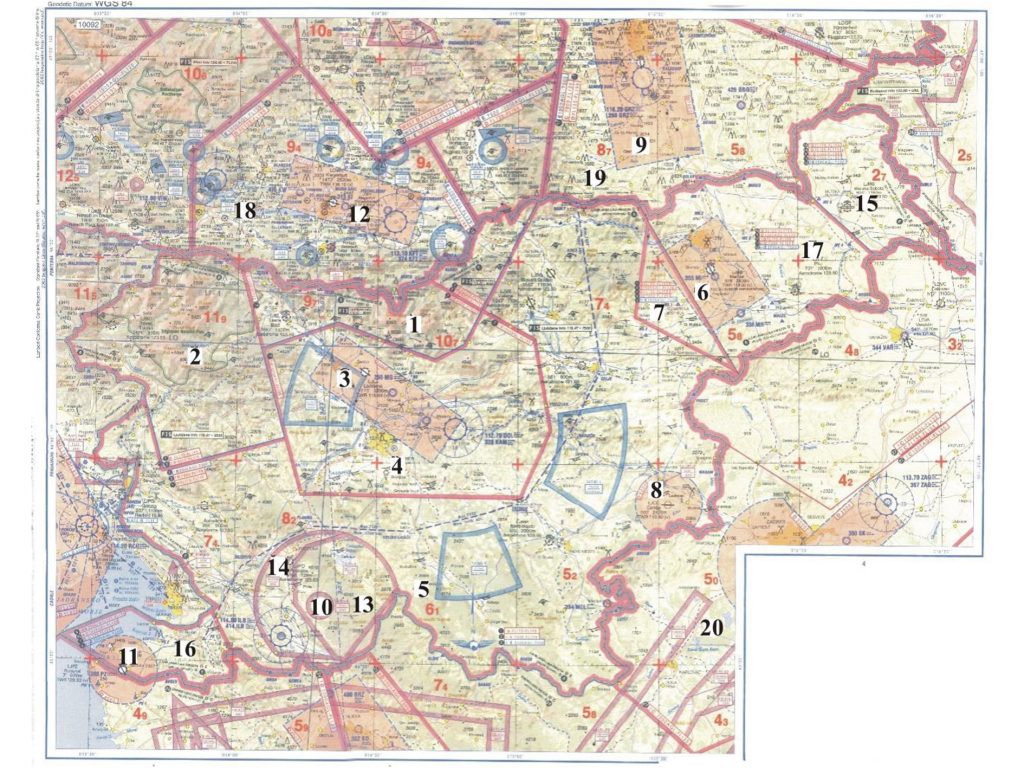
Z-12. Class G airspace (Annex nr. 2):
Z-13. Class E airspace (Annex nr. 2):
Z-14. At what points on the map is allowed to fly up to 2900 m MSL (Annex nr. 2)?
Z-15. At what points on the map is prohibited to fly from the ground (Annex nr. 2)?
Z-16. At what points on the map is prohibited to fly above 1000 ft AGL (Annex nr. 2)?
Z-17. Where is the class G airspace up to 2500m ft AGL and flying there might be prohibited or limited when NOTAM is issued due to military activities (Annex nr. 2)?
Z-18. Class G airspace above Karavanke is up to 2900 m MSL. Which airspace class is above this altitude?
Z-19. Up to what altitude we can fly in the area of Lijak, Ajdovščina, and Kovk?
Z-20. Above Preddvor, Golnik and Gornji grad class G airspace extends up to:
Z-21. Domžale and Moravče are located in airspace:
Z-22. Is flying allowed above city of Maribor?
Z-23. In the area of Slovenj Gradec, paragliding is allowed up to:
Z-24. Abbreviation NOTAM means:
Z-25. Do we need to check for NOTAM before flight?
Z-26. Where can we check for NOTAM?
Z-27. What is the minimum age limit to start with paragliding under instructor's supervision?
Z-28. How is the validity of paragliding license limited?
Z-29. How often must a technical check of the paraglider be done according to the document Decree on hang gliding and paragliding?
Z-30. At what time can a paraglider fly under the daytime visual flying rules?
Z-31. What is the minimum allowed altitude when flying over a group of people, roads, and electric wires?
Z-32. Who is setting the direction of circling in a thermal?
Z-33. Can a paragliding pilot fly in clouds?
Z-34. What is the minimum distance between paragliders when meeting at the same altitude?
Z-35. How do two pilots avoid each other when coming close at the same altitude near the slope?
Z-36. Can a pilot pass by another pilot at the same altitude, when they have the slope on the right side?
Z-37. Many paragliders are landing. Which one has priority?
Z-38. Can a paraglider land on a sport airport?